 in english
 en français
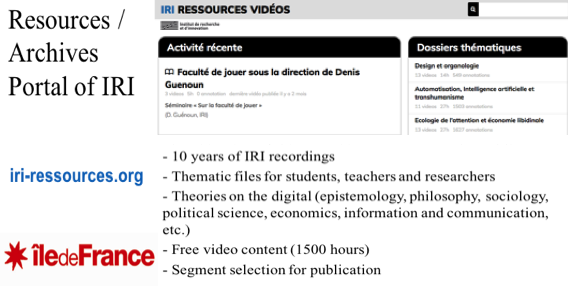

IRI has been created in 2006 by French philosopher Bernard Stiegler as part of the Centre Pompidou to anticipate, accompany and analyze the transformation of cultural practices enabled by digital technologies, and sometimes even to contribute to their very emergence. The institute, now an independent legal entity, primarily explores the field of digital studies, in the sense of a new “organology of knowledge” appearing with the digital, which requires specific studies and concepts. More precisely, the institute investigates the field of cultural and cognitive technologies from a digital humanities point of view, which at IRI is considered to be a specific sector of digital studies. IRI aims at participating in the development of new forms, devices and technologies: to address the public, to facilitate contributions and collaborative criticism; to provide solutions for editorial and interconnectivity in the domains of culture and knowledge. To achieve this, IRI both theorize and formalize the relevant technologies and the social practices they induce, as well as develop cultural and scientific applications, especially in and around the museum domain, but also more generally as technologies for amateurs/contributors.
IRI is a platform for reflection and development on the epistemological, cultural and political issues of the digital world closely articulating an international dimension within the framework of the Digital Studies network set up in 2012 (https://digital-studies.org ) and a territorial dimension with the Plaine Commune Participant Learning Territory project initiated in May 2016 (https://tac93.fr/).
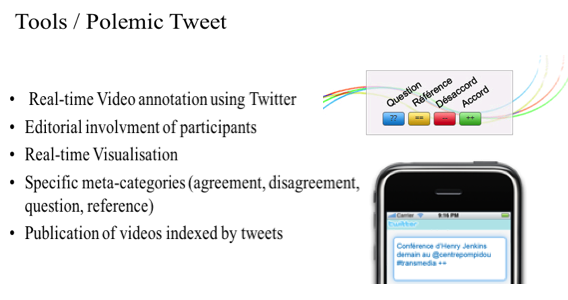
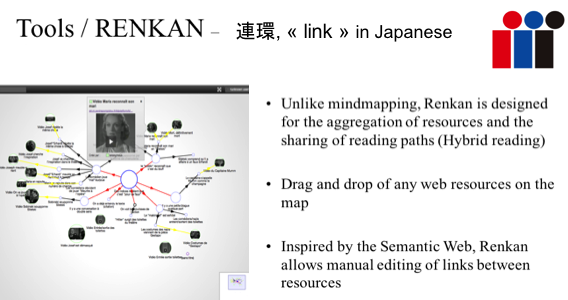
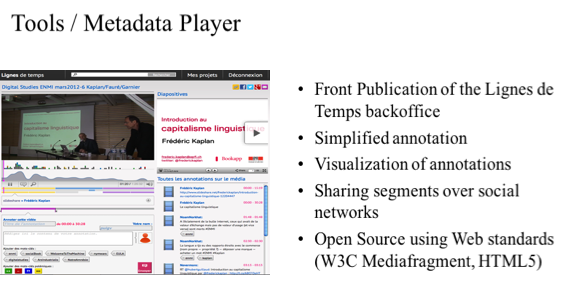
IRI has been developing and experimenting with different contributive platforms: Lignes de temps for films and vidéos, IconoLab for photos, Hypothes.is for texts in combination with innovative publication formats: videos indexed by categorized tweets (polemictweet.com), video mashups, mind mapping (Renkan), video-books, hyper-videos, contributive online courses. Tools and practices are experimented in the framework of national research projects or for the benefit of the Plaine Commune project.
Research axis currently include:
- Digital studies and digital hermeneutics
- Organology of metadata and contributive categorization
- Cultural technologies and learning platforms
- Contributive Publishing and social Networking.
IRI relies on the Internation collective for the definition and conduct of its research program and works closely with the Association of Friends of the Thunberg Generation-Ars industrialis for the development of territorial laboratories for the experimentation of the contributory economy.